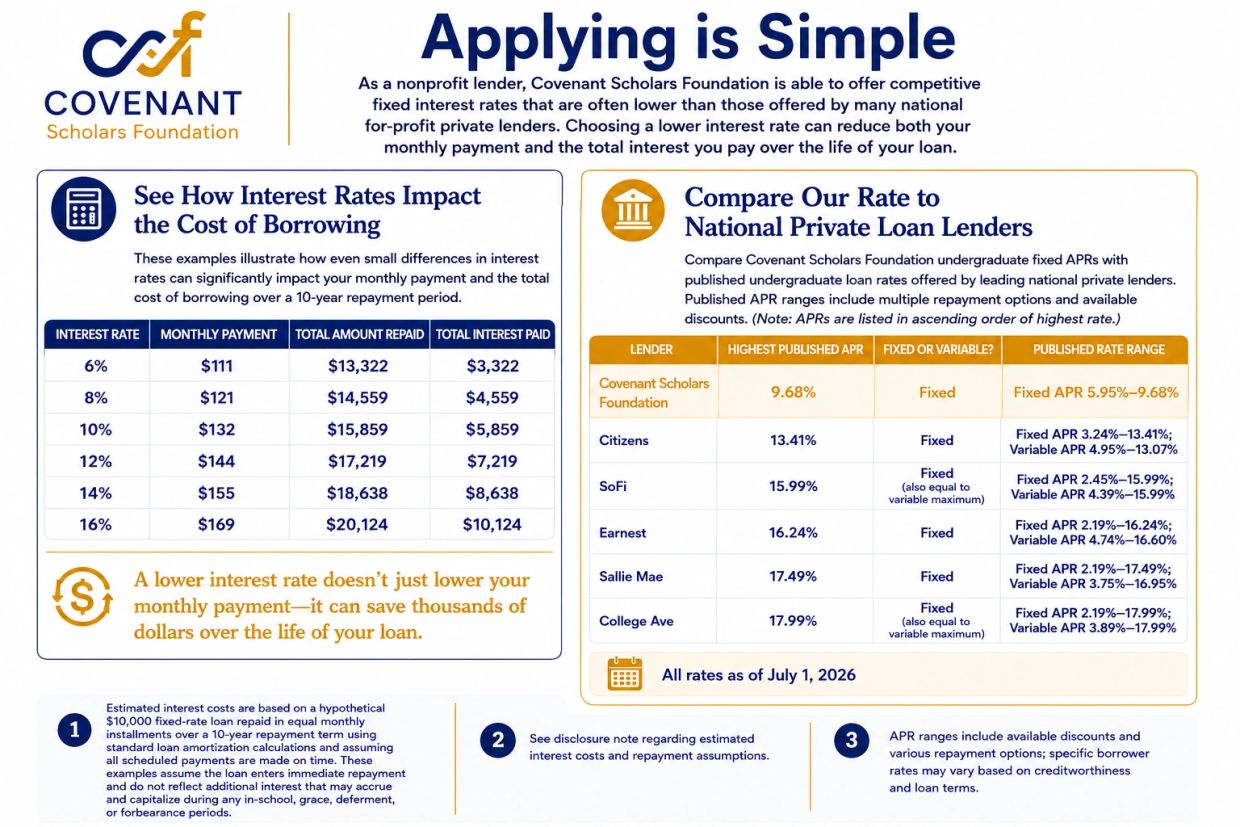
Undergraduate Loan: 5.95% APR - 8.70% APR
Graduate Loan: 6.95% APR - 9.68% APR


It's a simple idea.
We think you should know our credit requirements so you can determine if you qualify before applying.

There are both benefits and drawbacks to making payments of some sort while you're in school or postponing repayment until after your college days are behind you.

The Immediate Payment Option features our lowest rates and requires monthly principal and interest payments while you're in college. This option prevents increases to the loan balance when regular payments are made on time during college. Typically, you will pay this loan off faster than with the other two options and with lower overall cost.

The Interest-Only Payment option requires monthly interest payments while you're in college. Making interest payments during college prevents increases to the loan balance when regular payments are made on time and may be more financially manageable than making larger principal and interest payments during college years.
Note: Interest-onl
The Interest-Only Payment option requires monthly interest payments while you're in college. Making interest payments during college prevents increases to the loan balance when regular payments are made on time and may be more financially manageable than making larger principal and interest payments during college years.
Note: Interest-only payments cannot be made using our auto-debit system because the amount will change each month.

The Deferred Payment option postpones payments until after college. You will pay more overall due to interest accrual during college and a longer repayment term. Students and cosigners with tight budgets may prefer this option, with no prepayment penalty, instead of required payments each month.
1 The lowest annual percentage rates do not include a 0.25% interest rate reduction for enrolling in and maintaining auto-debit from the date of origination. If you are approved for a loan, the rate offered will depend on your credit profile, the term you select, and other terms and conditions, but the rate will be within the ranges shown above assuming the auto-debit interest rate reduction applies.
2 These calculations assume the student borrower makes no payments while in school and during a six-month separation period, for a total of 30 months where repayment is deferred. The interest rate is assumed to be the same during the in-school period and separation period and once the borrower enters a 10-year repayment period. No origination fees are included in these examples. Repayment plans that require interest-only monthly payments or principal and interest payments during the in-school period may result in smaller total interest charges.
3 Many lenders only offer limited information about their actual rates upfront. They do not provide all the rate details within the range of rates depicted on this graph. The specific rate an applicant is offered will be determined by the loan type selected and the applicant's or, if applicable, the cosigner's credit history and credit score. Annual percentage rates (APRs) were retrieved from the lenders' websites on July 1, 2026, for undergraduate fixed-rate loans for student borrowers while the student is enrolled at least half time. The ranges contain rates offered to applicants with a wide range of credit scores and for a variety of repayment options and terms; some non-CSF rates may be variable.
Because each lender offers different in-school repayment options and different repayment terms, an identical loan comparison between lenders is not possible. However, the APRs in the chart are listed as the highest and lowest rates for each lender and may include potential rate reductions that may not apply to every borrower. For example, a 0.25% automatic payment interest rate reduction (repayment benefit) has been included for the lowest rate displayed for all lenders as well as the highest rate for SoFi and College Ave. For complete details on how APRs were calculated, visit the lenders' websites.
Before applying for a student loan from any lender, you should consider additional characteristics, including: credit requirements, monthly payment amount, origination fees, capitalization frequency, borrower benefits and protections, repayment term, when repayment begins, and the total amount to be repaid over the life of the loan.
Copyright © 2026 Covenant Scholars Foundation, Inc.
All Rights Reserved.